
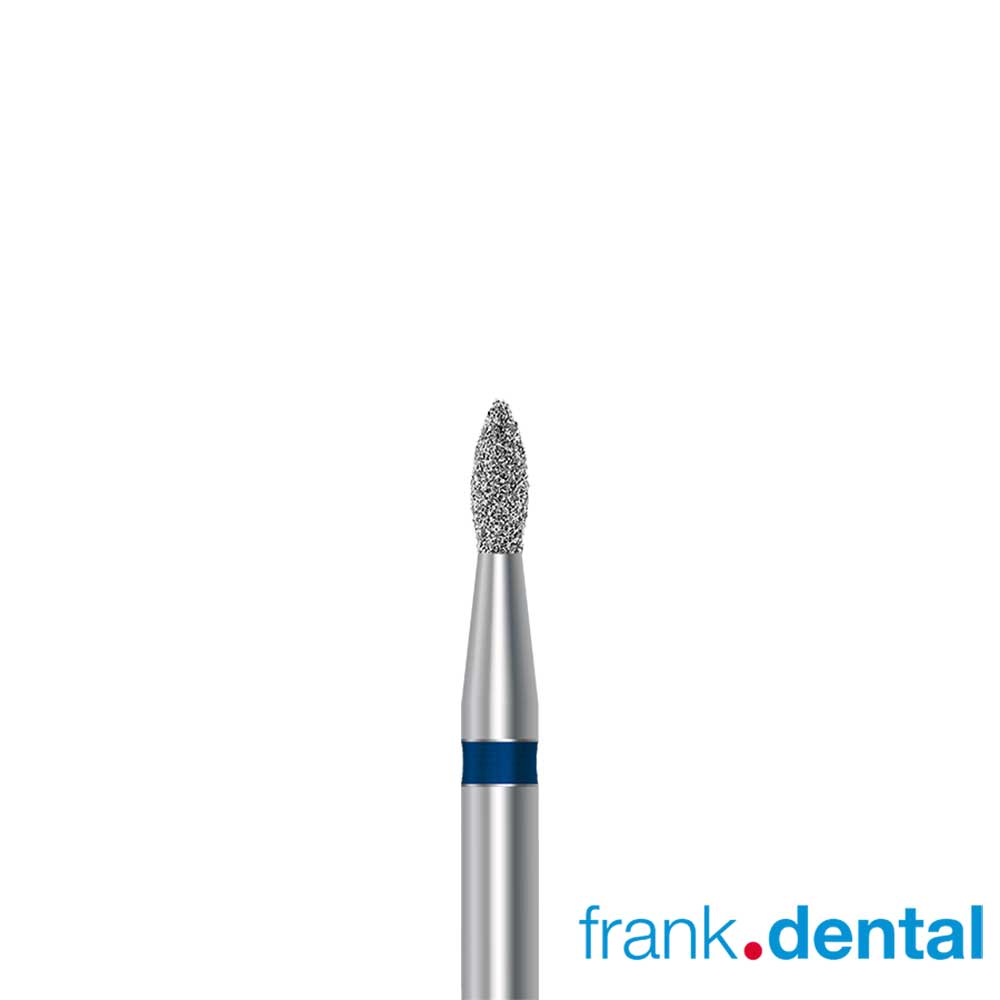
D.368.014.FG
Pack size: 5
Price per item: £3.85(ex. VAT) £4.62(inc. VAT)
Additional information
| Head Length | 4 |
|---|---|
| Total length | 19 |
| Shaft type | 314 |
| Shaft | FG |
| Max Revolutions | max. 225.000 |
| Procedure | Occlusal |
| Material | Diamond |
| Shape | Bud |
| Colour Ring | Blue |
| Grit | Medium |
| Material | Diamond |
| Diameter | 014 |
| Shank | FG – Friction Grip (High-Speed) |
General Enquiries
There are no enquiries yet.
Diamond drill bud
Frank Dental D.368 Egg / Bud Diamond Bur – Educational Guide to Lingual Reduction, Occlusal Contouring, Margin Refinement & Restorative Finishing
Precision Anatomical Contouring with the Frank Dental D.368 Egg/Bud Diamond Bur
The Frank Dental D.368 Egg/Bud Diamond Bur is a highly versatile rotary instrument designed for precise anatomical contouring, lingual and palatal reduction, occlusal reshaping, restorative finishing and crown preparation procedures.
Also commonly referred to as an egg-shaped diamond bur, bud diamond bur or flame-egg contouring bur, the Frank Dental D.368 is widely used in restorative dentistry, prosthodontics and cosmetic dentistry due to its unique shape and ability to follow natural tooth anatomy.
Manufactured using premium German-engineered diamond technology, the Frank Dental D.368 provides smooth cutting efficiency, exceptional tactile control and highly conservative tooth preparation across a wide range of clinical applications.
The distinct egg or bud-shaped profile combines:
- A rounded convex body
- A tapered pointed tip
- Smooth anatomical contouring surfaces
- Controlled cutting geometry
This allows clinicians to perform both broad reduction and fine detail work using a single diamond bur.
The Frank Dental D.368 Egg/Bud Bur is particularly useful because its shape naturally adapts to the curved anatomy of teeth, making it ideal for:
- Lingual and palatal reduction
- Occlusal reduction and contouring
- Crown preparation refinement
- Veneer preparation
- Margin finishing
- Composite adjustment
- Occlusal restoration shaping
- Cervical lesion smoothing
- Cavity refinement
- Bridge margin adjustment
For dentists searching for a high-quality egg diamond bur, bud diamond bur, lingual reduction bur or occlusal contouring bur, the Frank Dental D.368 offers exceptional versatility and precision for modern restorative dentistry.
What is an Egg or Bud Diamond Bur?
An egg or bud diamond bur features a rounded convex body with a tapered pointed end designed to follow the natural contours of the tooth.
Unlike straight fissure burs which produce flat surfaces, the D.368 creates smooth flowing anatomical contours while preserving natural morphology.
The broad central section of the bur allows efficient surface reduction while the pointed tip provides excellent access into narrow or difficult-to-reach areas.
This combination makes the Frank Dental D.368 one of the most versatile burs for restorative and prosthodontic procedures.
The shape is especially beneficial because it mirrors many of the natural curves found within tooth anatomy.
This allows dentists to:
- Reduce tooth structure conservatively
- Preserve natural anatomy
- Improve restorative transitions
- Create smoother contours
- Refine margins more precisely
- Improve restorative aesthetics
The D.368 is commonly used during crown preparation, veneer preparation, composite finishing and occlusal adjustment procedures because of its ability to perform both gross reduction and detailed refinement efficiently.
Lingual and Palatal Reduction
One of the primary uses of the Frank Dental D.368 Egg/Bud Diamond Bur is lingual and palatal reduction during anterior crown and veneer preparation.
The lingual and palatal surfaces of anterior teeth naturally feature concave anatomy which can be difficult to reproduce using straight burs.
The rounded convex sides of the D.368 adapt naturally to these surfaces, allowing clinicians to prepare teeth conservatively while maintaining anatomical form.
This is particularly important during:
- Anterior crown preparation
- Veneer preparation
- Palatal reduction
- Lingual contouring
- Functional guidance refinement
- Aesthetic restorative procedures
Using the correct bur shape during lingual reduction improves:
- Preparation smoothness
- Restoration thickness consistency
- Ceramic support
- Bonding predictability
- Final restoration aesthetics
The Frank Dental D.368 allows dentists to create controlled reduction while reducing the risk of flattening the palatal anatomy unnecessarily.
This is critical because over-flattened preparations may compromise:
- Restoration aesthetics
- Functional guidance
- Occlusal harmony
- Ceramic thickness distribution
The smooth curved profile of the D.368 supports more anatomical and minimally invasive preparation techniques.
Occlusal Reduction and Contouring
The Frank Dental D.368 Egg/Bud Diamond Bur is also highly effective for occlusal reduction and contouring of posterior teeth.
The broad midsection of the bur provides efficient contact with occlusal surfaces, making it ideal for reshaping biting surfaces while maintaining natural grooves and anatomy.
This is particularly useful during:
- Crown preparation
- Onlay preparation
- Occlusal adjustment
- Composite contouring
- Occlusal veneer preparation
- Functional cusp refinement
Unlike flat-ended burs which may create flat occlusal planes, the D.368 helps maintain natural cusp inclines and occlusal anatomy.
Maintaining anatomical occlusal form is essential because it improves:
- Functional efficiency
- Force distribution
- Patient comfort
- Restoration longevity
- Occlusal stability
The Frank Dental D.368 allows clinicians to remove tooth structure conservatively while preserving the natural shape of the occlusal table.
This is especially important when preparing teeth for ceramic restorations such as:
- Zirconia crowns
- Lithium disilicate restorations
- Ceramic onlays
- Occlusal veneers
- Tabletop restorations
Smooth anatomical preparations provide better support for modern restorative materials and reduce stress concentration areas within ceramics.


