
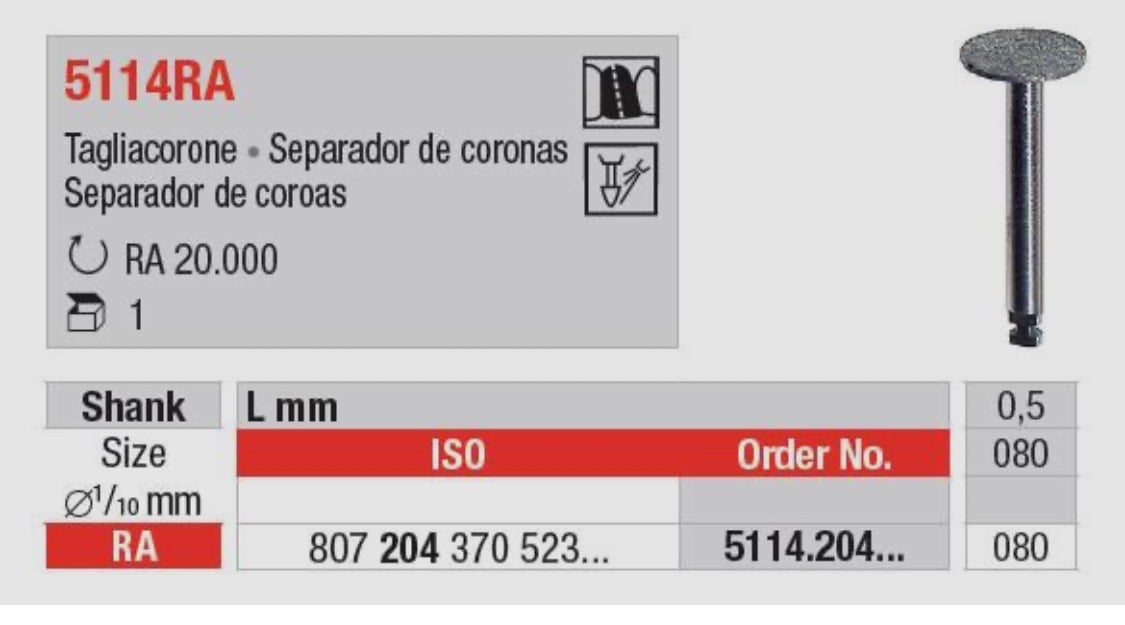
5114RA Latch Grip Sintered Diamond Wheel for all ceramic and Zirconia
Pack size: 1
Price per item: £31.50(ex. VAT) £37.80(inc. VAT)
I’ve checked the current Edenta technical information for the 5114RA, so I can make the copy SEO-focused while keeping the clinical/specification claims accurate.
EDENTA 5114RA Sintered Diamond Crown Cutter – RA
Specialist Crown Cutter for the Removal of All-Ceramic & Zirconia Restorations
The EDENTA 5114RA Crown Cutter is a specialist sintered diamond disc designed for the efficient sectioning and removal of all-ceramic and zirconia dental restorations.
Manufactured by EDENTA, the 5114RA provides clinicians with a purpose-designed rotary instrument for cutting a controlled slot through a ceramic restoration prior to its removal.
Unlike conventional diamond burs where the diamond abrasive is bonded primarily to the surface of the instrument, the 5114RA uses a sintered diamond construction. This makes it particularly suited to demanding applications involving hard restorative materials.
The disc configuration allows the clinician to section a restoration along the axial wall and continue towards the centre of the occlusal surface or incisal edge. Once adequately sectioned, the restoration can then be carefully opened with an appropriate instrument to encourage controlled fracture and removal.
For dental practices regularly removing ceramic crowns, zirconia crowns and other all-ceramic restorations, the EDENTA 5114RA offers a highly specialised alternative to attempting the procedure with a conventional diamond bur.
Key Features
- EDENTA 5114RA crown cutter
- Specialist sintered diamond disc
- Designed for crown and restoration removal
- Suitable for all-ceramic restorations
- Suitable for sectioning zirconia restorations
- RA / contra-angle shank
- Disc-shaped cutting geometry
- ISO size: 080
- Approximate diameter: 8.0 mm
- Approximate disc thickness: 0.7 mm
- Manufacturer reference: 5114RA / 5114.204.080
- Supplied as 1 instrument
- Designed for controlled sectioning before fracture and removal
- Use with appropriate coolant and according to the manufacturer’s current instructions for use
What is the EDENTA 5114RA Crown Cutter?
The EDENTA 5114RA is a rotary dental instrument specifically developed for the removal of hard ceramic restorations.
Modern restorative dentistry increasingly relies on high-strength ceramic materials because of their combination of aesthetics, strength and biocompatibility. Materials such as zirconia can, however, present a significant challenge when a restoration needs to be removed.
The properties that make zirconia an excellent restorative material can also make conventional crown removal more demanding.
The EDENTA 5114RA approaches this problem with a sintered diamond cutting disc.
Its disc geometry creates a narrow section through the restoration. Rather than unnecessarily reducing the entire restoration, the objective is to establish a section line through which the restoration can subsequently be fractured and removed.
This makes the 5114RA a useful addition to the crown-removal armamentarium of general dental practitioners, restorative dentists and prosthodontists.
Designed for All-Ceramic and Zirconia Crown Removal
The EDENTA 5114RA is particularly suited to the removal of all-ceramic restorations.
According to EDENTA’s recommended technique, an all-ceramic restoration is sectioned along the axial wall towards the centre of the occlusal surface or incisal edge using the 5114RA sintered diamond disc.
Once the restoration has been sufficiently sectioned, an appropriate instrument can be used to carefully open the restoration, encouraging it to fracture.
This approach can make removal more controlled than simply attempting to grind away the complete restoration.
The 5114RA may therefore be considered when removing restorations such as:
- Zirconia crowns
- All-ceramic crowns
- Ceramic restorations requiring sectioning
- High-strength ceramic restorations
- Restorations where a controlled sectioning approach is clinically appropriate
Always assess the individual restoration, underlying tooth structure and clinical circumstances before selecting the appropriate removal technique.
Why Can Zirconia Crowns Be Difficult to Remove?
Zirconia has transformed modern restorative dentistry.
Its mechanical properties allow laboratories and clinicians to create strong restorations that can withstand substantial functional forces. However, these same characteristics can make zirconia crown removal challenging.
When a zirconia restoration needs to be replaced because of recurrent caries, fracture, endodontic requirements, aesthetic concerns, marginal problems or another clinical indication, the clinician needs an instrument capable of working effectively against a very hard restorative material.
Standard rotary instruments may lose cutting efficiency during demanding crown-removal procedures.
This can result in:
- Increased chair time
- Frequent instrument changes
- Increased heat generation if inappropriate technique or cooling is used
- Reduced cutting efficiency
- Greater operator frustration
A specialist instrument such as the EDENTA 5114RA sintered diamond crown cutter provides another approach.
Rather than relying on a traditional bur shape, its disc geometry is intended to create the section required to facilitate subsequent fracture of the ceramic restoration.
Sintered Diamond Technology
One of the defining features of the EDENTA 5114RA is its sintered diamond construction.
Sintered diamond instruments differ from conventional electroplated diamond burs in the way the abrasive diamond particles are incorporated into the working component.
In a conventional diamond bur, abrasive particles are generally bonded to the exterior surface of the instrument.
With a sintered diamond instrument, diamond abrasive is distributed within the working material.
This construction is particularly useful where a durable abrasive cutting surface is required.
For the clinician, the important consideration is that the EDENTA 5114RA has been specifically engineered as a crown separator for demanding ceramic restorative materials, rather than being a general-purpose diamond bur.
Disc-Shaped Design for Controlled Sectioning
The shape of the 5114RA is an important part of its function.
Instead of the familiar tapered or cylindrical geometry of a conventional diamond bur, the 5114RA uses a thin disc-shaped working end.
This allows the clinician to establish a section through the restoration.
For an all-ceramic crown, the manufacturer’s technique involves cutting along the axial wall and continuing towards the middle of the occlusal surface or incisal edge.
The restoration can then be carefully opened with an appropriate instrument.
The purpose is not simply to grind away ceramic material. The instrument is being used to create a strategic section that assists the subsequent removal of the restoration.
RA Shank – Designed for the Contra-Angle
The EDENTA 5114RA features an RA shank, allowing it to be used with a compatible contra-angle handpiece.
This distinguishes it from many high-speed FG crown-cutting burs.
The RA configuration gives the clinician an alternative approach to crown sectioning and should always be operated according to EDENTA’s current instructions for use and the limitations of the handpiece being used.
Correct speed, coolant, instrument inspection and appropriate pressure are important considerations whenever cutting hard ceramic restorative materials.
EDENTA 5114RA Technical Specifications
Manufacturer: EDENTA
Product: 5114RA Crown Cutter / Crown Separator
Product reference: 5114RA
Order reference: 5114.204.080
Instrument type: Sintered diamond disc
Shank: RA / contra-angle
ISO size: 080
Diameter: Approximately 8.0 mm
Disc thickness: Approximately 0.7 mm
Primary indication: Sectioning all-ceramic and zirconia restorations prior to removal
Pack size: 1 instrument
Always refer to the current EDENTA Instructions for Use for definitive operating parameters.
How is the EDENTA 5114RA Used?
The EDENTA 5114RA is intended to assist with the controlled sectioning of an all-ceramic restoration.
The manufacturer’s recommended principle is to create a slot along the length of the axial wall, continuing towards the centre of the occlusal surface or incisal edge.
Once the ceramic restoration has been appropriately sectioned, a suitable instrument can be used to carefully open the restoration and encourage fracture.
The precise clinical technique will depend upon factors including:
- Restoration material
- Restoration thickness
- Cementation
- Crown design
- Position in the mouth
- Access and visibility
- Condition of the underlying tooth
- Presence of a core or post
- Reason for removal
Clinicians should use appropriate irrigation/cooling and follow the manufacturer’s current instructions.
A Specialist Instrument for Restorative Dentistry
Crown removal is an everyday procedure in many dental practices, but not every crown presents the same challenge.
A traditional metal or porcelain-fused-to-metal restoration requires a different approach from a monolithic zirconia restoration.
Having a selection of crown-removal instruments therefore allows clinicians to choose an instrument based on the restorative material being encountered rather than expecting a single bur to perform every procedure.
The EDENTA 5114RA is designed specifically for the ceramic side of that crown-removal workflow.
It can complement other crown-cutting burs used for:
- Metal
- PFM restorations
- Zirconia
- Lithium disilicate
- Other ceramic materials
This material-specific approach can help clinicians create a more organised and predictable crown-removal protocol.
When Might a Ceramic Crown Need Removing?
Even a clinically successful ceramic restoration may eventually require removal.
Common indications can include recurrent caries, endodontic treatment, restoration fracture, marginal deterioration, aesthetic replacement, occlusal changes, restoration failure or replacement as part of a wider restorative treatment plan.
In these situations, the clinician needs to gain access while maintaining appropriate control of the cutting procedure.
The EDENTA 5114RA provides a dedicated option for sectioning the ceramic restoration prior to removal.
Benefits of a Purpose-Designed Crown Cutter
Using an instrument specifically designed for the material and procedure offers several practical advantages.
Purpose-designed geometry
The disc shape allows the clinician to establish a section through the restoration rather than simply reducing a broad area of ceramic.
Sintered diamond construction
The sintered diamond working component is designed for demanding abrasive cutting applications.
Suitable for high-strength ceramics
The 5114RA is specifically indicated by EDENTA for the removal of all-ceramic restorations, including zirconia.
Controlled removal technique
Creating a defined section can allow the restoration to be subsequently opened and fractured with an appropriate instrument.
RA shank
The RA fitting enables use in a compatible contra-angle handpiece.
Specialist addition to a crown-removal kit
The 5114RA can sit alongside conventional carbide and diamond crown cutters, giving clinicians a broader choice when different restorative materials are encountered.
5114RA vs Conventional Diamond Crown Cutting Burs
Both instruments have a place within restorative dentistry, but they work differently.
A conventional diamond bur generally uses an electroplated abrasive surface and a bur-shaped working end. Depending on its design, it may be used at high rotational speeds to cut or reduce restorative material.
The EDENTA 5114RA uses a sintered diamond disc with an RA shank.
Its primary function is to establish the section required for removal of the ceramic restoration.
The appropriate instrument should therefore be selected according to the material, clinical situation and preferred removal technique.
Important Clinical Considerations
When cutting zirconia or another high-strength ceramic, appropriate technique is essential.
Clinicians should consider adequate cooling, correct rotational speed, controlled pressure, visibility and the remaining thickness of the restoration.
The objective is to section the restoration while maintaining control around the underlying tooth structure.
The instrument should be inspected before use and replaced if it shows signs of damage, excessive wear or other deterioration.
Cleaning, disinfection, sterilisation and reuse must always follow the manufacturer’s current Instructions for Use and the dental practice’s validated decontamination protocols.
Why Choose EDENTA?
EDENTA manufactures a wide range of rotary dental instruments and polishing systems for clinical and laboratory dentistry.
Its portfolio includes instruments for preparation, finishing, polishing, crown removal, ceramic adjustment and other specialist applications.
The 5114RA reflects this specialist approach by providing clinicians with an instrument developed specifically for sectioning demanding ceramic restorative materials.
For dentists who regularly work with modern all-ceramic restorations, having dedicated instruments available for both placement and removal is an important part of efficient restorative dentistry.
Frequently Asked Questions
What is the EDENTA 5114RA?
The EDENTA 5114RA is a sintered diamond crown-cutting disc designed for sectioning all-ceramic restorations before removal.
Is the EDENTA 5114RA suitable for zirconia crowns?
Yes. EDENTA identifies the 5114RA as a crown separator suitable for the removal of all-ceramic restorations, including zirconia.
Is the 5114RA a normal diamond bur?
No. It is a sintered diamond disc rather than a conventional electroplated diamond bur.
Is the EDENTA 5114RA FG or RA?
The 5114RA has an RA shank and is designed for use with a compatible contra-angle handpiece.
What size is the EDENTA 5114RA?
The 5114RA is listed as ISO size 080, corresponding to an approximate working diameter of 8.0 mm.
How thick is the disc?
Current EDENTA catalogue information lists the working disc thickness at approximately 0.7 mm.
What is the EDENTA order number?
The product is commonly identified as 5114RA, with the corresponding reference 5114.204.080.
How many are supplied?
The EDENTA catalogue lists the 5114RA as a single instrument.
How does it remove a ceramic crown?
The disc is used to section the restoration along the axial wall towards the centre of the occlusal surface or incisal edge. Once appropriately sectioned, the restoration can be carefully opened with a suitable instrument so that it fractures and can be removed.
Buy EDENTA 5114RA Crown Cutter Online
The EDENTA 5114RA Sintered Diamond Crown Cutter is a specialist rotary instrument for dental professionals looking for an effective solution for zirconia crown removal and all-ceramic restoration removal.
Its combination of sintered diamond technology, disc-shaped cutting geometry and RA contra-angle fitting makes it a valuable addition to a modern restorative crown-removal kit.
Whether removing an existing zirconia crown, replacing an all-ceramic restoration or building a comprehensive selection of material-specific crown-removal instruments, the EDENTA 5114RA provides a dedicated solution for demanding ceramic restorations.
Product: EDENTA 5114RA
Type: Sintered Diamond Crown Cutter / Crown Separator
Shank: RA
ISO Size: 080
Diameter: Approx. 8.0 mm
Primary Application: All-ceramic and zirconia crown removal
Pack Quantity: 1
Order the EDENTA 5114RA Crown Cutter
Add the EDENTA 5114RA Sintered Diamond Crown Cutter to your crown-removal selection and ensure your surgery has a specialist instrument available when a difficult all-ceramic or zirconia restoration needs to be sectioned and removed.
For professional dental use. Always follow the manufacturer’s current Instructions for Use, recommended operating parameters and appropriate infection-control procedures.


