D.PFXDS3-10_E Edenta IPR Strips 0.1mm
Pack size: 1
Price per item: £44.50(ex. VAT) £53.40(inc. VAT)
Additional information
| Head Length | N/A |
|---|---|
| Total length | 147 |
| Shaft type | N/A |
| Shaft | N/A |
| Max Revolutions | Filling treatment |
| Procedure | Interproximal Reduction |
| Material | Diamond |
| Shape | Diamond Strips |
| Colour Ring | Red |
| Grit | Fine |
| Material | Diamond |
| Diameter | N/A |
| Shank | N/A |
General Enquiries
There are no enquiries yet.
Diamond strips, with saw teeth (IPR/0.10)
Edenta Perforated IPR Strips – Premium Interproximal Reduction Strips for Orthodontics, Clear Aligners and Restorative Dentistry
Edenta Perforated IPR Strips – Precision Enamel Reduction with Maximum Control and Clinical Confidence
Edenta Perforated IPR Strips are premium-quality interproximal reduction strips designed to provide clinicians with accurate, controlled and predictable enamel reduction during orthodontic, restorative and cosmetic dental procedures. Manufactured in Switzerland by Edenta, a globally respected manufacturer of dental rotary instruments and finishing systems, these perforated abrasive strips combine exceptional cutting efficiency with outstanding tactile control, making them an essential tool for modern minimally invasive dentistry.
As the popularity of clear aligner systems such as Invisalign®, Spark™, SureSmile®, Angel Aligner and ClearCorrect® continues to increase, interproximal reduction (IPR) has become a routine part of orthodontic treatment planning. Clinicians require instruments that can create space safely, accurately and conservatively while preserving healthy enamel. Edenta Perforated IPR Strips have been developed specifically to meet these demands.
In addition to orthodontic applications, these versatile strips are widely used for composite finishing, veneer contouring, contact point adjustment, crown insertion refinements and cosmetic dentistry procedures where precision and control are essential.
Whether you are performing minor enamel reduction to relieve crowding, refining interproximal anatomy following composite bonding or adjusting contact points after crown placement, Edenta Perforated IPR Strips deliver predictable results and exceptional clinical performance.
What Is Interproximal Reduction (IPR)?
Interproximal reduction, often referred to as enamel stripping, slenderising or reproximation, involves the controlled removal of small amounts of enamel between adjacent teeth.
The procedure has become increasingly important within modern orthodontics because it enables clinicians to create space without resorting to extraction therapy.
By carefully removing fractions of a millimetre of enamel, practitioners can:
- Resolve crowding
- Improve tooth alignment
- Facilitate orthodontic movement
- Enhance smile aesthetics
- Improve contact point positioning
- Reduce black triangles
- Improve treatment stability
When performed correctly, IPR is considered a highly conservative procedure that preserves natural tooth structure while creating significant orthodontic benefits.
Why Clinicians Choose Edenta Perforated IPR Strips
Many IPR systems are available, including rotary discs, oscillating systems and mechanical handpieces. However, manual perforated strips remain a preferred choice for many clinicians because they offer superior tactile feedback and control.
Edenta Perforated IPR Strips provide several distinct advantages:
Precise Enamel Removal
The clinician remains in complete control throughout the procedure.
Conservative Treatment
Allows gradual reduction rather than aggressive enamel removal.
Excellent Visibility
The slim profile improves access and visualisation.
Reduced Risk of Over-Reduction
Material is removed incrementally and predictably.
Comfortable for Patients
Produces minimal vibration and reduced anxiety compared with rotary systems.
Versatile Applications
Suitable for orthodontic, restorative and cosmetic procedures.
These benefits make Edenta Perforated Strips one of the most trusted solutions for interproximal procedures.
The Advantage of the Perforated Design
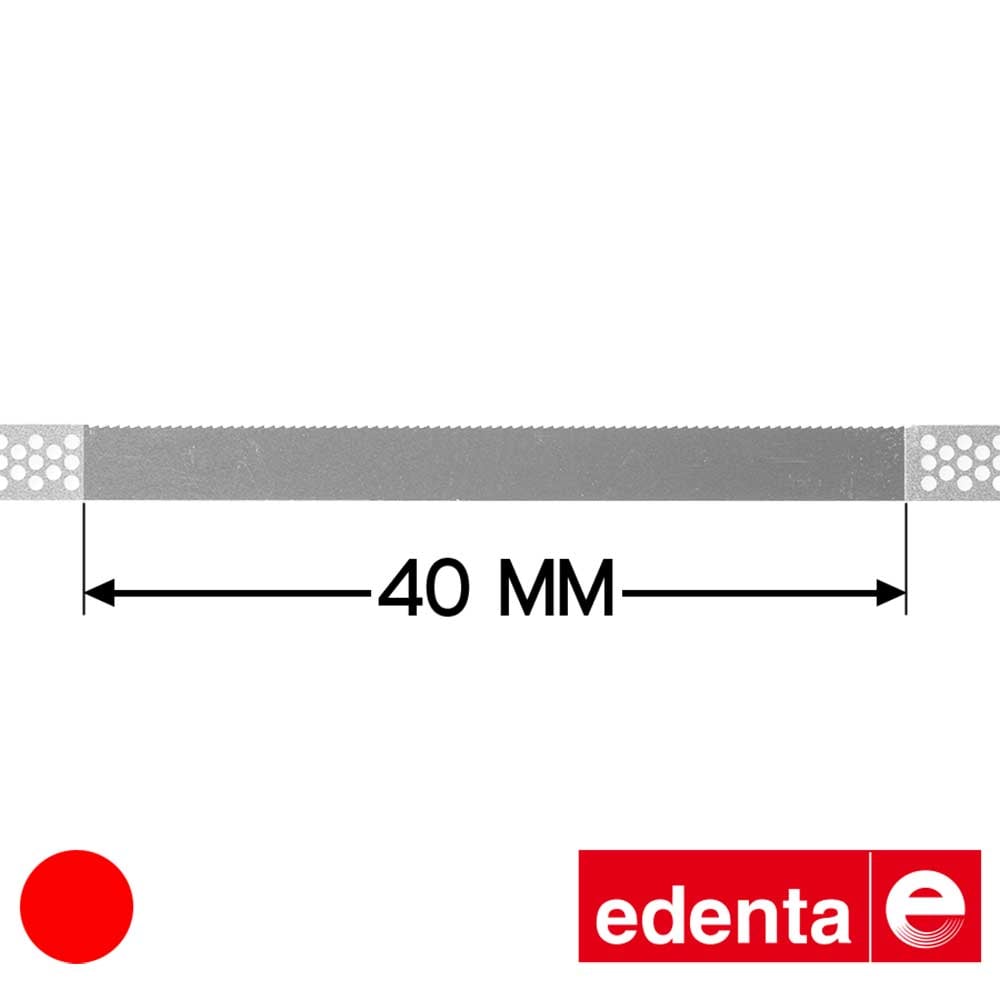
One of the defining features of Edenta IPR Strips is their perforated construction.
Unlike conventional solid abrasive strips, Edenta’s perforated design incorporates precisely engineered holes throughout the strip surface.
This unique feature provides significant clinical advantages.
Improved Debris Clearance
As enamel or composite is removed, debris is generated.
Traditional strips can become clogged, reducing cutting efficiency.
The perforations allow debris to pass through the strip, helping maintain abrasive performance throughout the procedure.
Enhanced Cutting Efficiency
Because the abrasive surface remains cleaner, clinicians experience more consistent cutting action from start to finish.
This helps reduce procedure time while improving predictability.
Greater Flexibility
The perforations increase strip flexibility, allowing easier adaptation to tooth anatomy and contact areas.
This is particularly beneficial when treating crowded teeth or difficult posterior contacts.
Reduced Heat Generation
The perforated structure reduces surface contact and friction, helping minimise heat generation during treatment.
Improved Tactile Feedback
Many clinicians report enhanced tactile sensation when using perforated strips, allowing more precise control over enamel reduction.
The Role of IPR in Clear Aligner Treatment
Clear aligner therapy has revolutionised orthodontics by offering patients a discreet and comfortable alternative to fixed appliances.
However, successful aligner treatment frequently depends on the strategic creation of space.
IPR is often prescribed to:
- Relieve crowding
- Improve tooth positioning
- Facilitate rotational movements
- Improve aligner tracking
- Optimise treatment outcomes
Without adequate space, teeth may struggle to move according to the digital treatment plan.
Edenta Perforated IPR Strips enable clinicians to create the required space accurately while maintaining maximum control.
Creating Space Without Extraction
Historically, moderate crowding often required extraction therapy.
Today, interproximal reduction offers a conservative alternative.
Benefits of space creation through IPR include:
- Preservation of natural dentition
- Reduced treatment complexity
- Improved aesthetics
- Better facial support
- Shorter treatment times in selected cases
Edenta Perforated Strips provide the precision necessary to achieve these goals while preserving healthy enamel.
Reducing Black Triangles
Black triangles are one of the most common aesthetic concerns encountered during orthodontic treatment.
These open gingival embrasures can develop when contact points are positioned too incisally or when triangular tooth anatomy is present.
Carefully planned IPR can help reposition contact points and reduce the appearance of black triangles.
Benefits include:
- Improved smile aesthetics
- Enhanced patient confidence
- Better tooth proportions
- More natural-looking treatment outcomes
Edenta Perforated Strips provide the accuracy required for these highly aesthetic procedures.
Composite Finishing Applications
Although often associated with orthodontics, Edenta Perforated IPR Strips are also extremely valuable in restorative dentistry.
Following composite placement, excess material frequently remains interproximally.
This excess can lead to:
- Difficult flossing
- Food impaction
- Gingival irritation
- Poor patient comfort
The flexibility and precision of Edenta Perforated Strips make them ideal for:
- Removing composite flash
- Refining contact points
- Smoothing margins
- Improving emergence profiles
- Finishing composite restorations
The result is a restoration that functions comfortably while maintaining excellent aesthetics.
Ideal for Composite Bonding Procedures
Modern composite bonding procedures demand meticulous finishing and contouring.
Patients expect restorations that appear completely natural.
Interproximal finishing is often one of the most challenging aspects of these treatments.
Edenta Perforated Strips allow clinicians to:
- Refine embrasures
- Shape contact areas
- Remove excess material
- Improve symmetry
- Enhance aesthetics
This contributes to highly polished and natural-looking outcomes.
Veneer and Cosmetic Dentistry Applications
When placing direct composite veneers or performing aesthetic contouring procedures, small refinements often have a significant impact on the final result.
Edenta Perforated IPR Strips help clinicians:
- Create natural embrasure forms
- Refine line angles
- Smooth restoration margins
- Improve emergence profiles
- Enhance overall aesthetics
Their precision makes them particularly valuable during cosmetic procedures where attention to detail is critical.
Crown and Bridge Applications
Following the placement of crowns, bridges or implant restorations, contact points occasionally require adjustment.
Edenta Perforated Strips provide a conservative method for:
- Refining proximal contacts
- Improving floss passage
- Eliminating minor interferences
- Smoothing restorative margins
This allows clinicians to optimise restoration fit without compromising surrounding structures.
Patient Comfort and Safety
Patient experience is an increasingly important aspect of dental care.
Compared with some rotary IPR systems, manual perforated strips often provide:
- Reduced noise
- Minimal vibration
- Less patient anxiety
- Improved comfort
- Better clinician control
Because enamel removal occurs gradually, patients often perceive the procedure as less invasive.
Preserving Healthy Enamel
One of the key principles of modern dentistry is the preservation of natural tooth structure.
Edenta Perforated IPR Strips support this philosophy by allowing clinicians to remove only the amount of enamel required.
Benefits include:
- Conservative treatment
- Reduced risk of over-reduction
- Preservation of enamel integrity
- Improved long-term tooth health
This makes them an ideal choice for clinicians committed to minimally invasive dentistry.
Available Grit Options
Edenta Perforated Strips are available in multiple abrasive grades to accommodate different stages of treatment.
Coarse Grit
Ideal for initial enamel reduction and space creation.
Medium Grit
Suitable for controlled reduction and contouring.
Fine Grit
Used for finishing procedures.
Extra Fine Grit
Creates smooth enamel surfaces following IPR.
Using progressively finer strips helps ensure optimal surface quality following reduction.
Why Smooth Enamel Matters
Research has demonstrated that surface texture influences plaque accumulation and oral hygiene.
Rough enamel surfaces may:
- Retain more plaque
- Feel rough to the patient
- Stain more readily
Finishing with finer abrasive strips helps create smooth, biologically compatible surfaces that are easier for patients to maintain.
Swiss Engineering and Quality
Edenta has been producing premium dental instruments for decades and is recognised worldwide for:
- Precision manufacturing
- Consistent quality
- Innovative designs
- Reliable performance
Swiss manufacturing standards ensure every strip delivers predictable and repeatable results.
Clinicians can therefore work with confidence knowing that the product will perform consistently throughout treatment.
Benefits for Orthodontists
Orthodontists choose Edenta Perforated Strips because they provide:
- Precise enamel reduction
- Excellent control
- Improved aligner outcomes
- Reduced risk of over-reduction
- Enhanced patient comfort
They remain one of the most trusted methods of performing IPR within orthodontic practice.
Benefits for General Dentists
General dentists benefit from their versatility.
Applications include:
- Composite finishing
- Contact adjustment
- Crown insertion
- Cosmetic contouring
- Minor orthodontic refinements
This makes them a valuable instrument for virtually every dental practice.
Clinical Advantages at a Glance
✔ Premium Swiss quality
✔ Perforated design for improved debris clearance
✔ Excellent flexibility
✔ Enhanced tactile feedback
✔ Conservative enamel reduction
✔ Ideal for Invisalign® and clear aligners
✔ Suitable for restorative dentistry
✔ Perfect for composite finishing
✔ Improves contact point management
✔ Helps reduce black triangles
✔ Multiple grit options available
✔ Supports minimally invasive dentistry
Frequently Asked Questions
What are Edenta Perforated IPR Strips used for?
They are used for orthodontic interproximal reduction, composite finishing, contact adjustment and cosmetic contouring procedures.
Why are perforated strips better than solid strips?
The perforations improve flexibility, reduce clogging and help maintain cutting efficiency by allowing debris to escape.
Are they suitable for Invisalign® treatment?
Yes. They are widely used during clear aligner therapy to create precise amounts of space between teeth.
Can they be used on composite restorations?
Absolutely. They are highly effective for removing excess composite and refining restoration margins.
Do they preserve healthy enamel?
Yes. Their manual design allows gradual and highly controlled enamel reduction.
Order Edenta Perforated IPR Strips from Crown Dental Burs
Edenta Perforated IPR Strips offer clinicians an exceptionally precise, conservative and reliable solution for interproximal reduction, restorative finishing and cosmetic contouring procedures. Their innovative perforated design enhances flexibility, improves debris removal and provides outstanding tactile control, helping clinicians achieve predictable results while preserving healthy tooth structure.
Whether you are carrying out Invisalign® IPR, reducing black triangles, refining composite restorations or adjusting contact points, Edenta Perforated IPR Strips provide the accuracy and confidence required for modern dentistry.
Trusted by orthodontists, cosmetic dentists and restorative clinicians worldwide, Edenta Perforated IPR Strips remain one of the most effective and versatile solutions for interproximal finishing and enamel reduction available today.