

TC390S.314.018
Pack size: 5
Price per item: £9.95(ex. VAT) £11.94(inc. VAT)
Additional information
| Procedure | Composite Shaping & Finishing |
|---|---|
| Shape | Grenade |
| Colour Ring | Blue |
| Grit | Medium |
| Diameter | 018 |
| Shank | N/A |
General Enquiries
There are no enquiries yet.
You may also like…
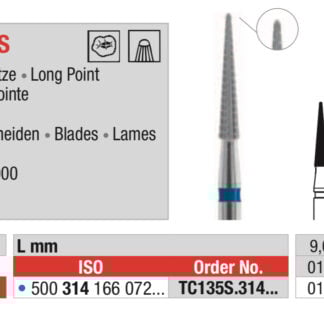
Edenta TC390S Composite S-Finisher – Advanced Flame-Shaped Tungsten Carbide Finishing Bur for Composite Restorations
The Ultimate Flame-Shaped Composite Finishing Bur for Anterior and Interproximal Composite Refinement
The Edenta TC390S S-Finisher is a premium Swiss-manufactured tungsten carbide finishing bur designed specifically for the shaping, contouring and finishing of modern composite restorations. Featuring Edenta’s innovative S-Finisher technology and a precision-engineered 12-blade flame-shaped design, the TC390S enables clinicians to efficiently refine composite restorations while producing an exceptionally smooth surface that significantly reduces the need for multiple finishing steps.
Traditionally, composite finishing required multiple finishing instruments to progressively improve surface quality. The development of Edenta’s S-Finisher system has transformed this workflow, allowing dentists to achieve outstanding surface smoothness in just two finishing stages when combined with an ultra-fine white band finisher. This streamlined approach saves valuable chairside time while improving the overall quality of composite restorations.
Whether you are placing direct composite veneers, performing composite bonding, refining Class III restorations, finishing interproximal composite restorations or completing aesthetic smile makeover cases, the Edenta TC390S provides exceptional control, cutting efficiency and surface quality.
What Is the Edenta TC390S?
The Edenta TC390S is a flame-shaped tungsten carbide S-Finisher designed for composite finishing procedures. The instrument features 12 precision-ground blades and a specialised cross-cut geometry developed specifically for composite restorative materials. The innovative blade design optimises cutting efficiency while simultaneously producing a remarkably smooth restoration surface.
The flame shape makes the TC390S particularly effective for:
- Facial surface refinement
- Interproximal finishing
- Cervical margin finishing
- Composite bonding procedures
- Veneer contouring
- Emergence profile refinement
- Composite margin blending
- Anterior composite restorations
Its slender profile allows excellent access to difficult areas while maintaining exceptional visibility and control throughout the finishing procedure.
The Evolution of Composite Finishing
For many years, composite finishing involved multiple sequential steps using standard, fine and ultra-fine finishing burs.
A traditional workflow often required:
Step 1
Standard carbide finisher
Step 2
Fine carbide finisher
Step 3
Ultra-fine carbide finisher
Step 4
Polishing system
Although effective, this workflow increased:
- Treatment time
- Instrument costs
- Sterilisation requirements
- Inventory management
Edenta developed the S-Finisher concept to simplify the process.
The result was a highly efficient two-step finishing protocol:
Step 1
TC390S S-Finisher
Step 2
Ultra-Fine White Band Finisher
This approach significantly reduces chairside time while producing superior surface quality compared with many conventional finishing systems.
Innovative S-Finisher Technology
The TC390S belongs to Edenta’s highly regarded S-Finisher range.
The “S” designation refers to a refined blade geometry that incorporates additional spiral cross-cutting technology designed specifically for composite finishing applications. This innovative cutting design optimises:
- Cutting performance
- Surface smoothness
- Material removal efficiency
- Handling characteristics
- Clinical predictability
The geometry combines rake angle, blade depth and blade spacing to maximise cutting efficiency while simultaneously producing a remarkably smooth surface.
Why Surface Quality Matters
The quality of a composite restoration is determined not only by the material selected but also by the quality of the finished surface.
A rough restoration surface can contribute to:
- Increased plaque retention
- Surface staining
- Reduced gloss retention
- Gingival irritation
- Increased wear
- Reduced patient satisfaction
A highly refined surface offers significant advantages:
Improved Aesthetics
Smooth restorations reflect light more naturally and closely mimic enamel.
Enhanced Stain Resistance
Reduced surface irregularities minimise staining potential.
Better Gingival Health
Smooth surfaces accumulate less plaque.
Greater Longevity
Highly polished restorations generally maintain aesthetics for longer.
The TC390S helps create the foundation for these long-term benefits.
Flame-Shaped Design Advantages
The TC390S features a flame-shaped profile specifically chosen to provide maximum versatility in aesthetic restorative procedures.
Benefits include:
Excellent Interproximal Access
The slender profile allows access to areas that are difficult to reach with larger finishing instruments.
Improved Margin Finishing
Clinicians can refine margins accurately without removing excessive material.
Enhanced Visibility
The shape improves visual access during finishing procedures.
Greater Precision
The tapered working area provides exceptional control when refining fine details.
Perfect for Composite Bonding
Composite bonding procedures require meticulous finishing if restorations are to blend seamlessly with surrounding enamel.
The TC390S allows clinicians to:
- Blend restoration margins
- Refine facial contours
- Smooth composite surfaces
- Improve emergence profiles
- Create natural transitions
The result is a restoration that becomes virtually invisible to the patient.
Ideal for Direct Composite Veneers
Composite veneers place particularly high demands on finishing instruments.
Patients expect:
- Natural appearance
- High gloss
- Smooth surfaces
- Long-term aesthetics
The TC390S provides exceptional control when:
- Refining facial anatomy
- Blending veneer margins
- Finishing cervical areas
- Adjusting line angles
- Smoothing facial surfaces
Its flame-shaped design makes it particularly effective when working in aesthetic zones.
Exceptional Performance in Class III and IV Restorations
Anterior restorations often require precise contouring and margin refinement.
The TC390S excels in:
Class III Restorations
Smooth interproximal finishing and contour refinement.
Class IV Restorations
Incisal edge refinement and facial surface finishing.
Diastema Closures
Seamless blending of composite additions.
Edge Bonding Procedures
Creation of natural enamel-like transitions.
Reduced Finishing Time
One of the greatest advantages of the TC390S is its ability to streamline finishing procedures.
The specialised blade design enables:
- Faster contouring
- Simultaneous smoothing
- Reduced instrument changes
- Improved workflow efficiency
For busy clinicians, these time savings can have a significant impact across multiple restorative procedures.
Swiss Precision Manufacturing
Edenta is internationally recognised for producing some of the finest rotary instruments available in dentistry.
Every TC390S is manufactured in Switzerland using:
- Premium tungsten carbide
- Precision grinding technology
- Advanced quality control systems
- Strict manufacturing tolerances
The result is:
- Consistent performance
- Exceptional durability
- Reduced vibration
- Superior handling
Clinicians benefit from predictable performance throughout the instrument’s lifespan.
Premium Tungsten Carbide Construction
The TC390S is manufactured from high-quality tungsten carbide.
Benefits include:
Exceptional Durability
Maintains cutting performance for extended periods.
Precise Cutting Action
Provides smooth and controlled finishing.
Consistent Results
Produces predictable clinical outcomes.
Reduced Instrument Replacement
Improves overall value and efficiency.
Recommended Composite Finishing Workflow
For optimal results, Edenta recommends a two-step finishing protocol.
Step 1 – TC390S S-Finisher
Used for:
- Shaping
- Contouring
- Initial finishing
- Surface refinement
The restoration surface is significantly improved while maintaining anatomy.
Step 2 – Ultra-Fine White Band Finisher
Used for:
- Final refinement
- Surface smoothing
- Enhanced gloss potential
This process creates an exceptionally smooth restoration surface ready for final polishing.
The Perfect Foundation for Polishing
Once finishing has been completed using the TC390S and an ultra-fine finisher, the restoration is ready for polishing.
The smoother the surface before polishing, the easier it becomes to achieve a high-gloss result.
The TC390S works exceptionally well alongside:
- EVE Diacomp
- EVE Composoft
- Diamond polishing systems
- Composite polishing pastes
The result is a highly aesthetic restoration with outstanding gloss retention.
Clinical Applications
The Edenta TC390S is suitable for:
Direct Composite Veneers
Composite Bonding
Class III Restorations
Class IV Restorations
Diastema Closure
Composite Smile Makeovers
Composite Repairs
Interproximal Composite Finishing
Margin Refinement
Facial Surface Contouring
Cervical Margin Finishing
Aesthetic Composite Procedures
Key Features
- Premium Swiss-manufactured tungsten carbide finisher
- Flame-shaped design
- Innovative S-Finisher technology
- 12-blade cutting geometry
- Designed specifically for composite finishing
- Excellent interproximal access
- Enhanced surface quality
- Reduced finishing time
- Supports two-step finishing workflow
- Exceptional durability
- Improved aesthetic outcomes
- Excellent margin refinement
- Compatible with all major polishing systems
Benefits at a Glance
- Faster composite finishing
- Fewer instrument changes
- Improved surface smoothness
- Enhanced restoration aesthetics
- Better gloss potential
- Reduced plaque retention
- Superior margin finishing
- Exceptional durability
- Swiss precision engineering
- Predictable clinical outcomes
Why Dentists Choose the Edenta TC390S
The Edenta TC390S has become a trusted finishing instrument among clinicians who demand efficiency, precision and aesthetic excellence.
Dentists choose the TC390S because it provides:
- Reliable performance
- Exceptional surface quality
- Efficient workflows
- Improved restoration aesthetics
- Long-lasting durability
When combined with an ultra-fine finishing bur and a high-quality polishing system, the TC390S helps clinicians consistently produce restorations that closely mimic the appearance and feel of natural enamel.
Conclusion
The Edenta TC390S S-Finisher is a highly advanced flame-shaped tungsten carbide composite finishing bur designed to simplify and improve modern restorative workflows. Featuring innovative S-Finisher technology, a precision 12-blade cutting design and Swiss manufacturing quality, the TC390S allows clinicians to efficiently shape, contour and refine composite restorations while producing exceptional surface quality.
Ideal for composite bonding, veneers, Class III and IV restorations, interproximal finishing and smile makeover procedures, the TC390S delivers outstanding clinical performance, improved efficiency and highly aesthetic results. For dentists seeking a premium composite finishing instrument capable of reducing treatment times while enhancing restoration quality, the Edenta TC390S remains an indispensable addition to every restorative setup.
S-Finisher
Finishing a composite filling is reduced from 3 to 2 steps using the S Finishers.
Step (1) = S Finisher, step (2) = Ultra-fine
Finisher (white ring). Highlustre polishing is then completed using the TopGloss one-step diamond grit polisher (3).


