
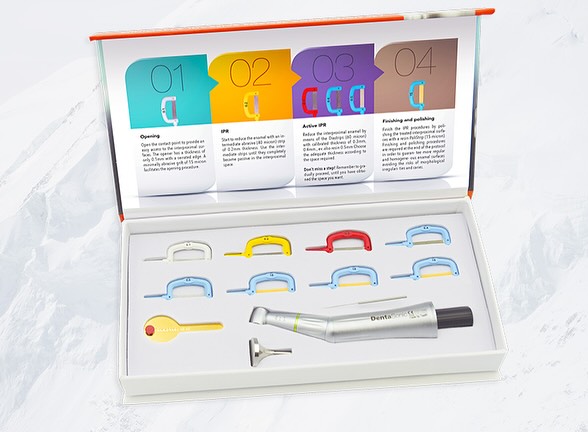
The Evolution of IPR in Modern Dentistry
Interproximal reduction (IPR) has become an essential procedure in modern orthodontics, clear aligner therapy and minimally invasive dentistry. However, many clinicians still rely on manual abrasive strips or traditional disc systems that can be time-consuming, difficult to control and uncomfortable for patients.
The IPR System has been designed to change this completely — delivering a faster, safer and more precise approach to enamel reduction.
Following clinical feedback from dentists using the system in practice and on educational courses, the DentaSonic system is quickly becoming one of the most talked-about mechanical IPR systems available today.
What Makes the DentaSonic IPR System Different?
One of the biggest advantages clinicians immediately notice with the DentaSonic handpiece is the level of precision and control during treatment.
Unlike manual strips which can feel inconsistent and labour intensive, the DentaSonic system provides:
- Controlled and accurate enamel reduction
- Faster treatment times
- Excellent visibility
- Predictable polishing and finishing
- Improved patient comfort
- Increased soft tissue safety
The handpiece feels exceptionally stable during use, allowing clinicians to carry out highly controlled IPR procedures with confidence — particularly when performing minimal reductions of 0.2 mm to 0.3 mm.
Significant Time Savings Compared to Manual IPR
For many dentists and orthodontists, one of the most frustrating parts of traditional IPR is the amount of chair time required.
Manual abrasive strips can be slow, physically demanding and difficult to use in posterior areas.
The DentaSonic IPR system dramatically reduces treatment time by allowing clinicians to perform enamel reduction efficiently while maintaining excellent control.
This not only improves workflow efficiency within the practice but also creates a smoother and more comfortable patient experience.
For busy clear aligner clinics and orthodontic practices, reducing treatment time while maintaining accuracy is a major clinical and financial advantage.
Improved Soft Tissue Safety and Patient Comfort
A major concern with many rotary IPR systems is accidental trauma to gingival tissues.
One of the standout features repeatedly highlighted by clinicians using the DentaSonic system is its safety around soft tissues and gingiva.
The system has been praised for its ability to safely perform IPR with minimal risk of soft tissue trauma, helping increase patient confidence during treatment.
This is particularly important for:
- Nervous patients
- Younger orthodontic patients
- Minimal reduction cases
- Posterior interproximal areas
By improving both clinician confidence and patient comfort, the DentaSonic system helps create a more predictable and stress-free IPR procedure.
Excellent Polishing and Surface Finishing
Achieving smooth, polished enamel surfaces after IPR is critical for long-term clinical success.
The DentaSonic polishing burs allow clinicians to quickly create highly polished and beautifully contoured interproximal surfaces after reduction.
A smoother enamel finish can help:
- Improve patient comfort
- Reduce plaque retention
- Enhance aesthetics
- Create more natural interproximal contours
The ability to complete both reduction and polishing efficiently within one workflow makes the DentaSonic system an ideal solution for modern orthodontic and restorative dentistry.
Easy Access Even in Posterior Areas
Although the assembled handpiece may initially appear larger than traditional systems, clinicians consistently report that it is surprisingly manoeuvrable in practice.
This is particularly beneficial when carrying out limited IPR in posterior regions where access can often be difficult using conventional systems.
The stable design of the handpiece helps clinicians maintain precision even in challenging clinical situations.
When Should Manual Strips Still Be Used?
As with any mechanical IPR system, correct case selection remains important.
In cases involving heavily overlapping teeth or extremely tight contacts, initial separation with manual abrasive strips may still be beneficial before introducing the mechanical bur.
However, once access has been established, the DentaSonic system allows clinicians to complete the procedure significantly faster and more predictably than manual methods alone.
Why More Dentists Are Choosing the DentaSonic IPR System
The DentaSonic system combines:
- Precision
- Efficiency
- Safety
- Patient comfort
- Excellent polishing
- Predictable clinical outcomes
As clear aligner therapy and minimally invasive orthodontics continue to grow, clinicians are increasingly searching for reliable and efficient IPR systems that improve workflow without compromising control.
The DentaSonic mechanical IPR system delivers exactly that.
Order the DentaSonic IPR System Online
Looking for a faster, safer and more predictable approach to interproximal reduction?
Discover the benefits of the IPR system and upgrade your orthodontic workflow today.
Ideal for:
- Clear aligner treatment
- Orthodontics
- Cosmetic dentistry
- Restorative finishing
- Minimal enamel reduction procedures
Browse the full DentaSonic range online today.
Customer Testimonial by Dr Ahmed AlKaaky (Manchester)
“The DENTASONIC IPR handpiece delivers a precise, controlled and highly efficient IPR experience. The biggest advantage for me was the significant time saving compared to conventional methods.
What stood out most was the safety around soft tissues and gingiva, greatly improving patient comfort and confidence during treatment. The polishing burs also create beautifully polished and well-contoured surfaces very quickly.
Despite initially appearing large, the handpiece is surprisingly easy to manoeuvre, even in posterior areas where minimal IPR can be challenging.
Overall, I am extremely pleased with the product and will be promoting it during our courses and clinical demonstrations.”


