
Why You Should Always Finish a Tooth Preparation with a Fine Grit Diamond Bur
(With Frank Dental Clinical Examples)
When preparing a tooth for a crown, veneer or indirect restoration, most clinicians focus on reduction, taper and margin design.
However, one critical clinical step is often underestimated:
Surface refinement after coarse reduction.
If you complete your preparation using only a coarse diamond bur (107–181µm particle size), you may be leaving deep surface trauma that can affect restoration fit, stress distribution and long-term success.
What Scratch Depth Does a Coarse Diamond Bur Create?


A coarse grit diamond bur (107–181 microns) — typically identified by a green band — is designed for rapid enamel and dentine reduction.
Example Frank Dental Coarse Burs:
-
D.847KR.016.G.FG – Shoulder preparation (Green band)
-
D.856.016.G.FG – Chamfer preparation (Green band)
These burs are excellent for:
-
Bulk axial reduction
-
Occlusal clearance
-
Rapid ceramic removal
-
Efficient crown preparation
Typical Scratch Depth
A coarse diamond with a particle size of 107–181µm can create:
-
Scratch depths of approximately 40–120µm
-
Deep linear grooves across axial walls
-
Irregular enamel and dentine surface patterns
-
Micro-fracture propagation at margins
While ideal for speed, this is not an ideal final preparation surface.
Why Surface Roughness Matters in Modern Dentistry
Deep surface grooves can:
-
Increase stress concentration beneath ceramic restorations
-
Reduce marginal precision
-
Scatter light during intraoral scanning
-
Affect crown seating
-
Influence bonding consistency
As digital workflows and adhesive protocols advance, controlled surface topography becomes increasingly important.
The Clinical Benefit of Refining with a Fine Grit Diamond (27–76µm)
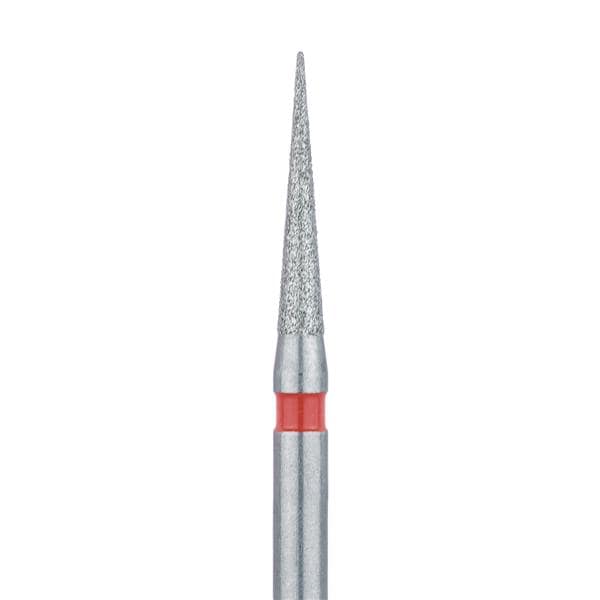

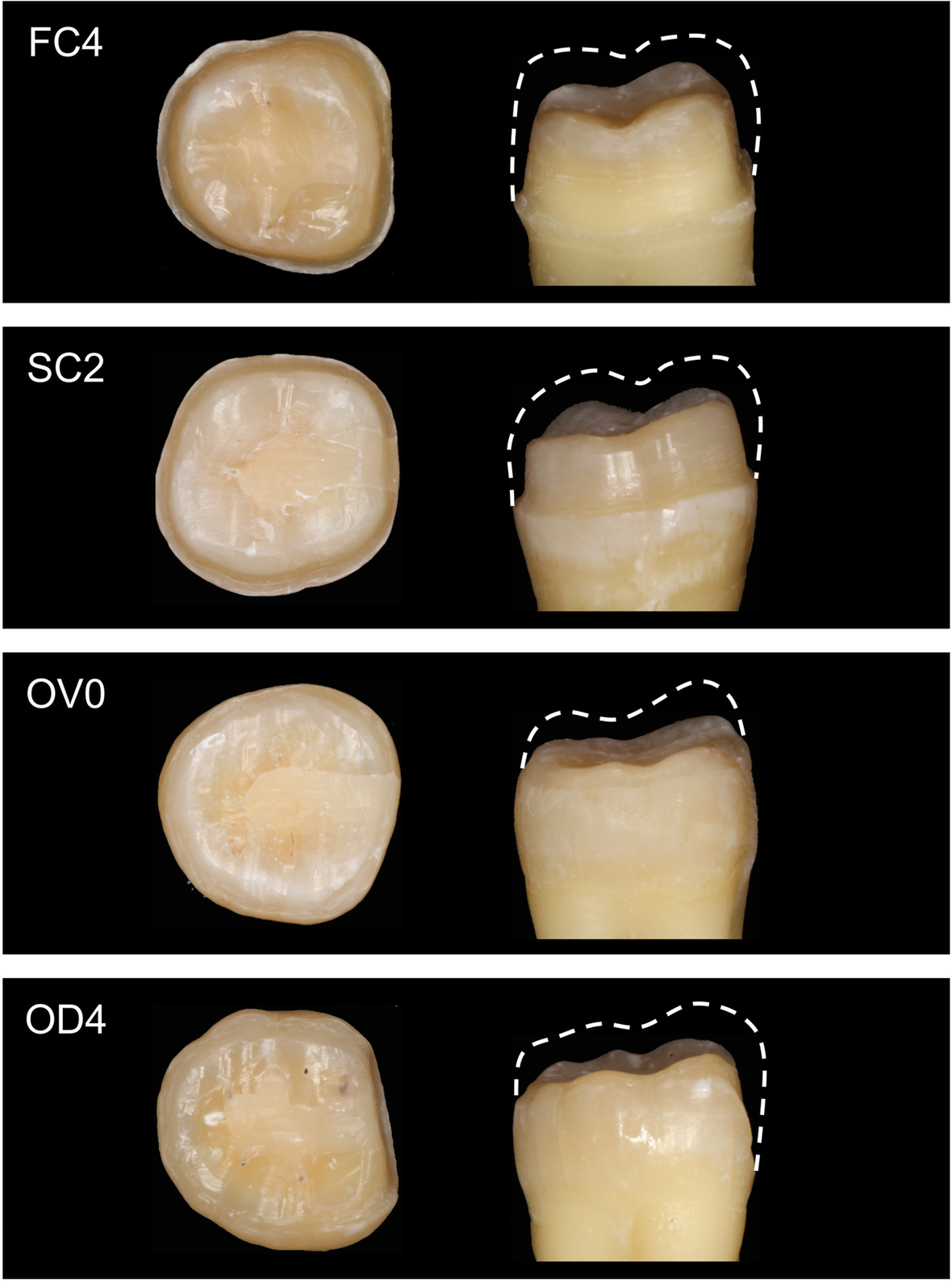
A fine grit diamond bur (27–76 microns) — red band — is specifically designed for margin refinement and surface smoothing.
Frank Dental Fine Grit Examples:
-
D.847KR.016.F.FG – Fine shoulder refinement
-
D.856.016.F.FG – Fine chamfer refinement
-
D.830L.016.F.FG – Fine pear refinement for cavity margins
What Refinement Achieves
-
Reduces scratch depth significantly
-
Smooths axial walls
-
Sharpens margin clarity
-
Removes unsupported enamel
-
Produces more uniform surface roughness
Typical Scratch Depth After Fine Refinement
Using a fine diamond reduces scratch depth to approximately:
-
10–30µm
-
Shallower and more uniform grooves
-
Improved light reflection for digital scanning
-
Reduced stress concentration under ceramics
This represents a dramatic improvement compared to coarse-only preparation.
Coarse vs Fine Diamond: Clinical Comparison
| Feature | Coarse (Green 107–181µm) | Fine (Red 27–76µm) |
|---|---|---|
| Purpose | Rapid reduction | Margin refinement |
| Scratch Depth | 40–120µm | 10–30µm |
| Surface Roughness | High | Controlled |
| Margin Definition | Irregular | Sharper & smoother |
| Scanner Accuracy | Light scatter | Improved capture |
| Stress Concentration | Higher | Reduced |
Why This Matters for Zirconia & Ceramic Restorations
When preparing for:
-
Monolithic zirconia
-
Lithium disilicate
-
Layered ceramics
Surface refinement helps:
-
Reduce internal stress points
-
Improve restoration seating
-
Enhance long-term ceramic performance
Skipping fine refinement means accepting unnecessary surface trauma beneath your restoration.
The Ideal Frank Dental Workflow
For predictable crown preparation:
1️⃣ Bulk Reduction
-
D.847KR.016.G.FG (Shoulder)
-
D.856.016.G.FG (Chamfer)
2️⃣ Contour Refinement (Optional Medium Blue)
3️⃣ Fine Margin Refinement
-
D.847KR.016.F.FG
-
D.856.016.F.FG
4️⃣ Optional Extra-Fine (Yellow 10–36µm) for ultra-smooth margins
The Clinical Takeaway
Coarse diamonds give you speed.
Fine diamonds give you precision.
Finishing every preparation with a fine grit diamond bur:
✔ Reduces scratch depth
✔ Improves surface uniformity
✔ Enhances digital accuracy
✔ Supports crown fit
✔ Reduces stress under ceramics
✔ Elevates preparation quality
Refinement is not an optional step — it is the final stage that transforms a preparation from functional to excellent.


